Hello! Kiah here. Welcome to Fintech Takes Banking, my weekly newsletter where I highlight things I think are interesting or important for bankers and the surrounding environs.
The one good thing about going onto Alex’s podcast to talk about “Die Hard” (which will be out tomorrow!) is that it allowed me to do some archival research in advance of the episode. This research was fun and informative, and so I decided to share what I learned. This newsletter will heavily cite and link to The New York Times’ archive, the links of which may not be available without a subscription. |
Was this email forwarded to you? |
|
|
A Brief History of Bearer Bonds, 1960s-1988 |
I saw “Die Hard” all the way through for the first time in December 2019. It didn’t take long before I thought I misheard something. I had to pause, backtrack 30 seconds, hit play again.
What bonds? What did he say? Bear-er bonds? I had been a financial reporter for about a decade at this point, and felt like I had a good shot at knowing most financial instruments. The Great Financial Crisis has its own set of jargon, which I had arduously learned. So what was a bearer bond?
Bearer bonds are the financial instrument at the heart of the drama of the 1988 action film “Die Hard.” The U.S. subsidiary of the Nakatomi Corp. has $640 million of them in its vault, and Alan Rickman’s Hans Gruber and a band of burglars decide to take the holiday party hostage to steal them. But the film doesn’t actually address what they are, why they’re special and why I had never heard of them. That’s what I’m going to do today.
|
A rough overview first: Bonds are a way for investors to lend money to companies and governments, called the issuer, in exchange for interest payments over the bond's duration and a return of the borrowed funds when the bond matures. Most interest payments are fixed and, in bond parlance, are called the coupon.
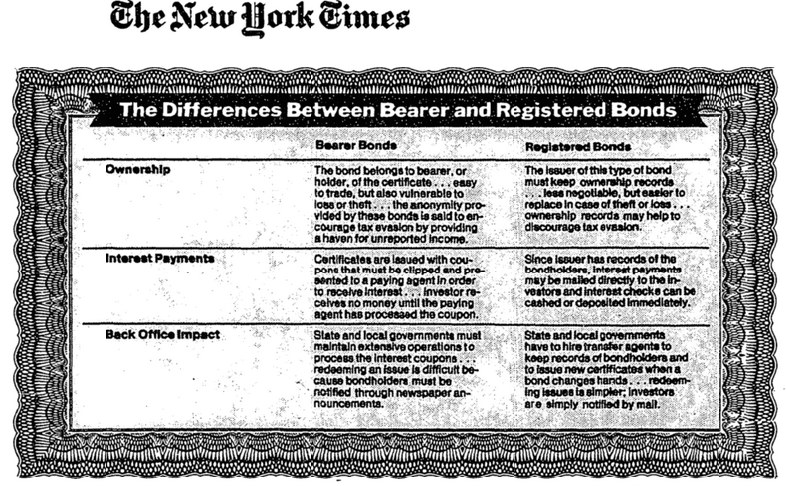
Today, issuers, or their agent, maintain a record of who holds the bonds, so they know who they owe interest to. These bonds are called registered bonds. The record of ownership allowed the issuer to disburse interest payments to bondholders; it also made it easier to replace the bond in case of theft or loss. A list! So smart! So novel! So not the common practice until the late 20th century. |
In the latter half of the 20th century, issuers could opt to issue either registered or unregistered bonds (this period is squishy for reasons we will get into). Unregistered bonds were also called “bearer bonds” because whoever possessed them would be considered the owner of them.
Without the registration record listing ownership, companies had no way to verify ownership. The investor of a bearer bond would only be paid after physically presenting a bond or interest coupon. The lack of registration meant there wasn’t a way for the issuer of a bearer bond to report to the government how much interest had been paid to whom. Instead, the bondholder was expected to self-report this income.
In the early 1960s, more than 90% of marketable Treasury debt was in bearer form, according to a 2004 paper from the Federal Reserve Bank of New York. But the Treasury stopped selling bearer notes or bonds in 1982 (a change brought about in part because of a cache of missing bearer bonds at a reserve bank!!), and corporations stopped issuing them in the mid-1960s. It was just too much work and expense to secure and track these bonds and for back-office finance teams to manage interest payments that came through mailed coupons.
The pool of bearer bond issuers shrank to being basically just municipal governments, but there were tens of thousands of those. By 1978, nine states and Puerto Rico were still selling bearer bonds, according to a congressional committee looking into this issue. It’s not clear who issued the bonds that Nakatomi Corp. owns, but the fan wiki page notes that they were issued in 1979.
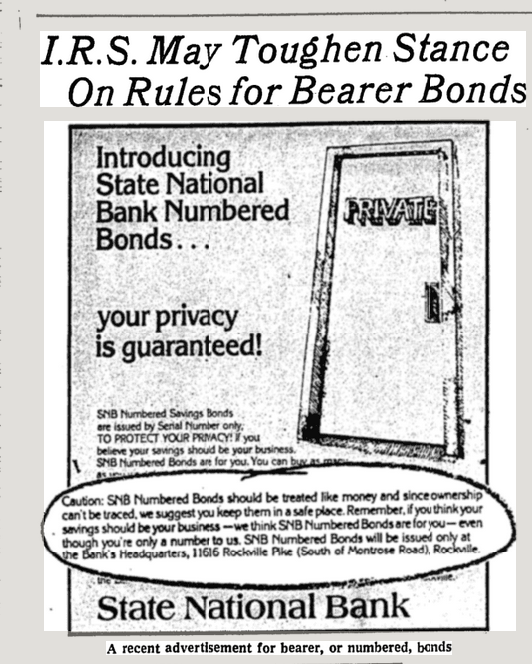
Banks at the time seemed to realize their attractiveness to investors, marketing them “aggressively” to small investors and using coded language such as “honor bonds,” “no‐name bonds” and “numbered bonds,” according to a 1978 article in The New York Times. Institutions in New Jersey and Maryland offered them in denominations as low as $25 from their previous floor of $100,000; one bank in California was reportedly selling the bonds through the mail. An Ohio bank advertised that the bank “will not furnish interest information about bearer bonds to the I.R.S. and that whoever holds them is ‘honor bound to report the interest received,’” the Times reported.
|
Advertisement from a bank that was reprinted in The New York Times in 1978 |
The same article reported that two banks in Pennsylvania sold $11 million of these bonds in two weeks, according to the same article; that is the equivalent of $54.7 million in today’s dollars. In response, the state’s secretary of banking ordered state-chartered banks to cease selling these bonds — an action that the Times notes seemed rare among officials. |
The Constitutional Question |
Bearer bonds’ ability to help people underreport their taxable income made them subject to political pressure. A Congressional representative estimated that bearer bond sales were in “the hundreds of millions of dollars,” costing the Treasury “tens of millions” of dollars in lost revenue. In 1978, Congress started pressuring the Internal Revenue Service and the Treasury Department to look into the issue.
The IRS responded in 1978 by proposing to close a loophole in the law that exempted banks from reporting the interest they paid depositors on bearer bonds. They would now be required to report the names and Social Security numbers of people who purchase new bearer bonds in denominations of $100,000 or less. They would also need to provide the same information, plus what interest had been paid, on individuals who had previously redeemed bonds.
To reinforce that change, Congress passed the Tax Equity and Fiscal Responsibility Act of 1982 (TEFRA), which forbade entities that can issue tax-exempt bonds, like states and local governments, from issuing bearer bonds. By July 1, 1983, all new municipal bond issuances were required to be sold in registered form.
Some, but not all, municipalities were already issuing registered bonds by this time. For example, the Municipal Assistance Corp. for the City of New York had issued registered bonds since the mid-1970s, and they accounted for 35% of the MAC’s $8.8 billion of outstanding debt by 1983, according to a 1983 article from The New York Times.
“The registered bond system is far simpler and precludes a host of problems,” the deputy executive director of MAC said at the time. “In the case of coupon bonds that are lost, stolen, or that have slipped the memory of the holder, there is no simple solution. In the case of bond calls, the only way we can notify holders is through purchases of newspaper advertisements listing the bonds that have been called.”
Registered bonds by this point were increasingly maintained using the “book-entry” system. Investors would “forgo physical delivery of bonds in favor of a safekeeping arrangement with the broker or bank, which, in turn, keeps the bonds with a centrally situated depository. When bonds are traded, records are changed, but there is no physical transfer of bonds unless the investor insists upon it,” according to the article. “[I]nvestors must be satisfied with a sales receipt and electronic record-keeping of their holdings,” it added.
|
Screenshot of the New York Times from Thursday, May 19, 1983 |
Book-entry for muni bonds was gaining in popularity and trust, due to convenience and security. It cost $6 a year to safekeep a bearer municipal bond in the mid-1980s, compared to $1.50 for a book-entry Treasury, according to a citation in the 2004 New York Fed article. The Depository Trust Co. went from having less than $2 billion of munis in its book-entry system at the start of 1982 to $19.9 billion by early May of that year.
But some municipalities wouldn’t change without a fight. In 1987, South Carolina challenged the constitutionality of TEFRA. “The state contends that the doctrine of reciprocal immunity, under which the states do not tax Federal securities and the Federal Government does not tax state securities, is overturned by the registered bond rule,” the Times wrote in 1983. The case, S.C. vs. Baker, was heard by the U.S. Supreme Court in December 1987.
In April 1988, the court ruled that the federal government can tax interest from state and local bonds. The decision overturned a major precedent set back in 1895 and upheld the TERFA provision that made interest on unregistered muni bonds taxable. The majority opinion by Justice William J. Brennan Jr. included the concern that unregistered bonds “facilitated tax evasion.”
Die Hard came out two months later. |
The Long, Slow Death of Paper Bond Certificates |
It can’t be stated enough: Before issuer registration and the proliferation of electronic payments, redeeming bearer bond coupons was a highly manual process that was cumbersome and annoying. It was ripe for technological disruption.
The bearer bondholder would tear off the bond’s coupon at the correct interest interval, which would be in the bond booklet or attached to the bond, and bring it to their bank. The bank would put bond coupons “in envelopes, each of which contains coupons from bonds issued by a particular corporation, state, city or authority with the same denomination and maturity date.”
At small banks, those envelopes would be sent to a larger correspondent bank; large banks would send the envelopes to the bank that acted as those bonds’ paying agent. The paying agent would send the payment back through the same pipeline until it was deposited into the customer’s account. The entire process could take up to two weeks, The Times reported in 1984; by that time, some banks had moved from treating these like cash deposits to charging fees.
Registered bonds were an important step toward dematerialization, which is the electronic registration of securities ownership. Everyone knew paper was anachronistic: it could be stolen, forged, put into the wrong file, eaten by rats or accidentally shredded or tossed. But it took the financial system decades to move away from it, and bearer bonds had some role in resisting that evolution. As of 1997, there were still about $99 billion in bearer bonds in circulation; as late as 2000, Britain and Germany were still issuing bearer bonds.
The New York Times was still writing articles in 2000 about financial institutions trying to eliminate paper certificates. (This article also talks about the aesthetics and security characteristics of the physical stock certificates, including the vignettes engravings on the front of the certificates, and how all the companies that did that work would lose that business, if that’s of interest to you.) All bearer bonds issued by the U.S. Treasury had matured by May 2016, with $87 million still to be redeemed as of March 2020.
One reason why bearer bonds are interesting and fun to think about now — outside of plot devices in movies — is that they’ve been somewhat reincarnated. One recurring theme in Matt Levine’s newsletter is how “Crypto constantly reinvent[s] or rediscover[s] things that finance had been doing for centuries.” It’s not hard to see parallels between this antiquated, now extinct asset and a newer, technology-forward asset.
“Bitcoin is easily transferable, easily negotiable and anonymous and it has distinct advantages over currency. It operates like cash, but also has the potential to gain more value, like bearer bonds,” wrote Cara Baros in a 2014 University of Miami Business Law Review article. “The two are similar, for example, once a Bitcoin is stolen, it cannot be retrieved or replaced. Thus, there is a criminal element in the types of transactions that a person can enter using Bitcoin, and there is an advantageous criminal element related to stealing another individual’s Bitcoin, straight from his or her computer.”
Taxing gains on crypto income hasn’t led to the asset class’s demise, unlike what Baros hypothesized in 2014. But it doesn’t mean the other consequences haven’t been realized: The theft, the misplacement, the potential for abuse.
Bearer bonds, to me writing in 2025, seem kind of insane: a financial instrument that embodied the technology available at the time, the disadvantages and limitations of which became its own type of advantage. There is a good reason why I hadn’t heard about bearer bonds until I watched “Die Hard.” I live in a world of electronic, centralized lists maintained by computers owned by companies capable of recording my purchased securities, receiving my interest and reporting my income for tax purposes. I never think about any of these things, never worry about them, don’t really track them. It took a long time for the financial system — the issuers, the government, the financial institutions — to get here, but thank God we did.
I don’t think we’d revert to this world if we had the chance, but who knows? |
|
|
What I’ve been reading, watching and listening to this week: |
🎁 Please tell me: Most of your holiday shopping has concluded. Some online ideas include my favorite annual subscriptions to my oft-discussed budgeting app, You Need a Budget, and a password manager like 1Password. (None are affiliate links, not even YNAB. Trying to be an honest dealer here!)
📊 Appreciating: this in-depth article from Bloomberg about why it’s so hard to get rid of Microsoft Excel, why artificial intelligence struggles with spreadsheet and just… an appreciation of why spreadsheets have infiltrated so much of our lives.
🤨 Thinking about: why there’s so much debate around increasing deposit insurance coverage, since uninsured deposits don’t really take losses when a bank fails since 2008. I spoke with Professor Michael Ohlrogge about his research that revealed this fascinating realization — and what it was like in years when uninsured depositors would regularly take losses — in my final Bank Nerd Corner podcast of 2025.
|
Thanks for reading! I promise this will not be the last time I write about this; the history of bearer bonds is fertile ground for content. But next week, I will be writing my quarterly recap — please reply to this email and let me know what you thought was the biggest news of the last three months. And if you’re enjoying this newsletter, please forward it to someone who might also like it!
– Kiah |
|
|
Get your brand in front of 55,000+ financial services execs. |
Workweek Media Inc.
1023 Springdale Road, STE 9E
Austin, TX 78721
Want to ruin my day? Unsubscribe. |
|
|
|